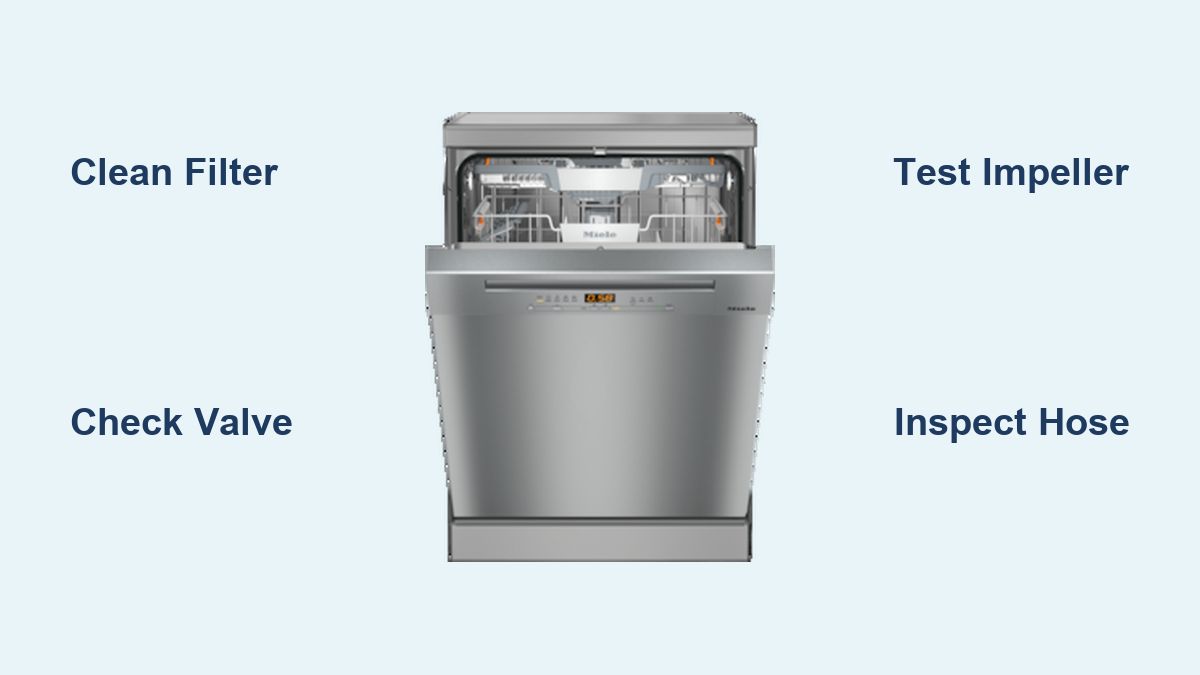
Miele Dishwasher Not Draining? Fix It Fast
If your Miele dishwasher not draining, you are not alone. Standing water in the tub after a cycle is one of the most common and frustrating issues Miele owners face. The good news? In over 90% of cases, the problem is not a failed motor or expensive electronic fault. It is a blockage or simple mechanical issue you can fix yourself in under 30 minutes.
This guide cuts through the noise and gives you a clear, step-by-step path to restore full drainage. You will learn how to inspect the non-return valve, clean the impeller, clear the drain hose, and avoid costly service calls. Whether you are seeing error code F11, silence during the drain phase, or just a puddle of soapy water, we will help you diagnose and resolve it fast.
Confirm Standing Water and Check for F11 Error
Start by confirming the problem. Open the dishwasher after a completed cycle. If you see 1–2 cm of water, that is normal. Miele leaves a small amount to protect seals. But if water rises above the filter or covers the sump, you have a drainage issue.
Look at the control panel. Is the Drain light flashing or is error code F11 displayed? F11 means the dishwasher detected water remaining after the drain phase. It is the system is way of saying: “I tried to empty, but I could not.”
Before opening the unit, try a manual drain attempt. Press and hold the power button, select a different wash program, and close the door. This triggers a new drain sequence. Repeat up to four times. If water drains, the issue may be temporary. If not, proceed to disassembly. Always unplug the dishwasher first or turn off the circuit breaker. Safety comes before speed.
Clean the Triple Filter to Prevent Clogs
The triple filter is the first line of defense against drainage failure. It traps food debris and prevents it from reaching the pump. When neglected, it becomes a clog source itself.
To remove the filter, press the recessed grips on the filter flap in the direction of the arrows. Lift the flap and pull out the entire assembly.
Disassemble the three parts. The coarse filter goes on top, the fine filter in the middle, and the filter basket on the bottom. Rinse each under hot running water. Use a soft brush to scrub off grease or stuck-on food. Pay attention to the underside of the fine filter. Users often find a hard crust of food there after months of neglect.
Reinstall only when dry and clean. Push the filter firmly into place until it clicks. If it is not fully seated, debris will bypass it and jam the impeller.
Clean the filter weekly. It takes 2 minutes and prevents 80% of drainage issues.
Inspect the Non-Return Valve for Blockages
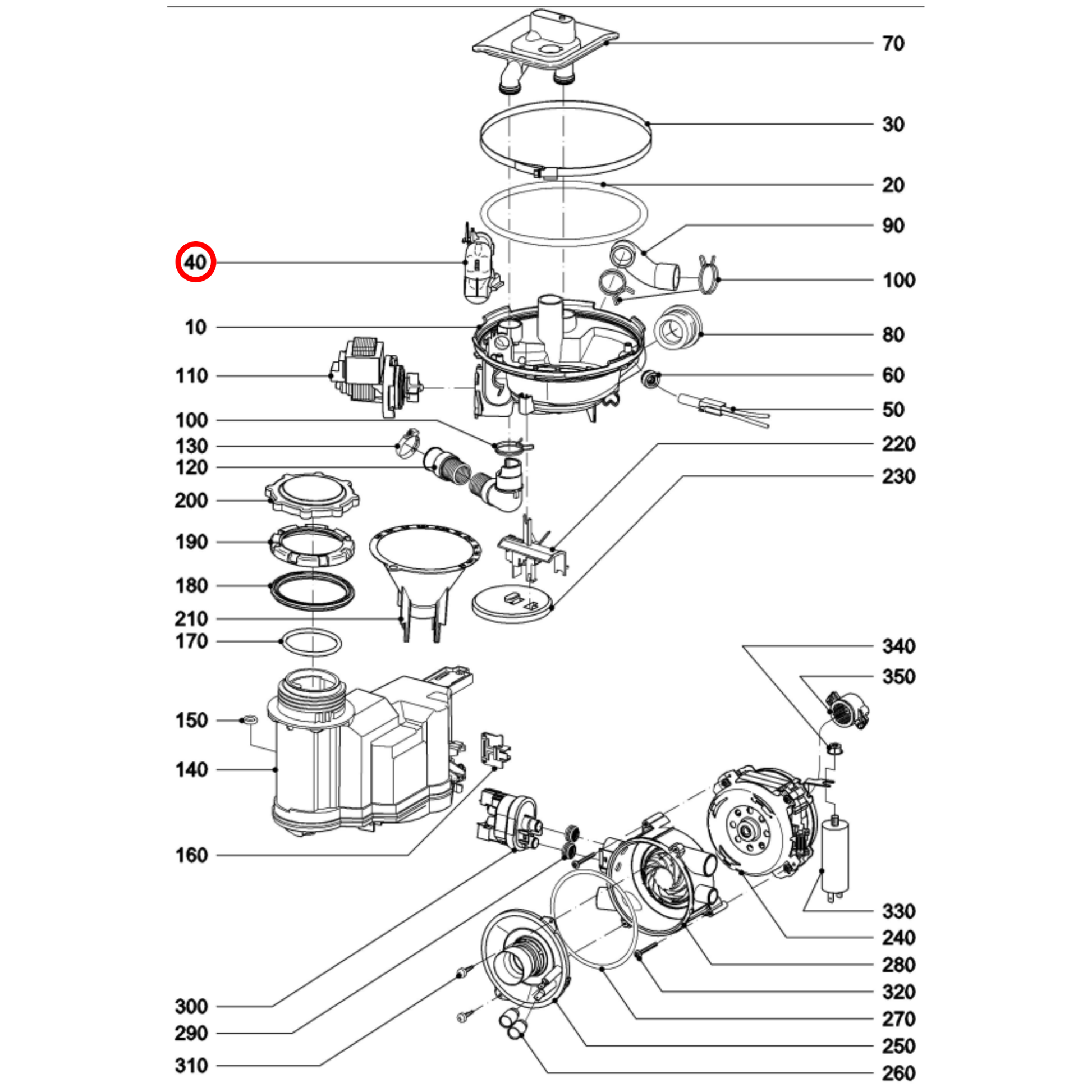
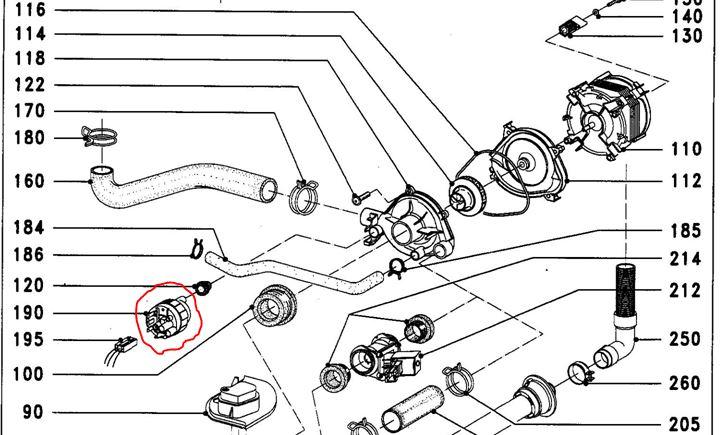
Located under the filter basket or on the left side of the sump, the non-return valve stops wastewater from flowing back into the dishwasher. It contains a silver ball bearing and a rubber seat. If debris blocks the ball or cracks the rubber, the valve cannot seal, and drainage fails.
To remove the valve, pull it upward at a 45-degree angle toward the center of the sump. Never pull straight up. It distorts the rubber seal and causes leaks.
Separate the two halves by hand. No tools needed. Remove the black rubber gasket and ball bearing. Rinse all parts under water.
Check the following. Does the ball drop freely when the valve is held vertically? Is the rubber seat cracked or deformed? Are there seeds, plastic labels, or glass fragments stuck inside?
Reassemble carefully. Insert the rubber gasket with the hole facing right. Align the tab on one half into the rubber opening of the other. Press firmly until it clicks. Reinsert at the same 45-degree angle.
A misaligned or damaged valve is a top cause of recurring drainage problems.
Test the Drain Impeller for Resistance
With the filter and non-return valve removed, you will see the impeller. This is a small propeller in the sump where clogs often hide.
Rotate it with your finger. You should feel a slight bumping or ratcheting resistance every few degrees. That is the magnetic coupling working correctly.
If it spins smoothly and freely, the internal shaft is broken. Water will not move, even if the motor runs.
Look for porcelain shards, cherry or olive pits, rice grains, and plastic labels. Use a flashlight to inspect the underside. Glass splinters are common and hard to see. Remove all debris by hand or with tweezers.
If the impeller turns with resistance and no blockage is found, it is likely functional. If it spins freely, the drain pump assembly must be replaced.
A free-spinning impeller almost always means internal mechanical failure, not a blockage.
Check the Drain Hose for Kinks and Clogs
The drain hose runs from the dishwasher to the sink drain, garbage disposal, or air gap. Even a small kink can block flow.
Trace the entire hose. Look for sharp bends, flattening, or compression. Confirm it forms a high loop 20–30 inches above floor. The loop prevents back-siphoning and must not be eliminated.
Disconnect the hose at the disposal or drain point. Place a bucket underneath. Use a wet/dry shop vac on suction mode to pull out clogs. Alternatively, flush with hot water and mild detergent.
If water flows slowly, the hose is partially blocked. If no water moves, the clog is severe or the pump is dead.
Many users find rice stuck near the disposal. They thought the hose was clear.
Verify Garbage Disposal Knockout Plug
If your dishwasher drains into a garbage disposal, the knockout plug must be removed. This plastic disc blocks the connection port and is often left in place during disposal replacement.
To check the plug, disconnect the dishwasher hose from the disposal. Look into the inlet port. If you see a small plastic plug, it needs to be knocked out.
Use a screwdriver and hammer to break it out. Run the disposal with cold water to flush any debris.
After reattaching the hose, test drainage with a short cycle. If water now drains, the knockout plug was the culprit.
New disposals come with the plug installed. It is not automatic.
Diagnose Persistent F11 Error Code
F11 appears when water remains after the drain cycle. It is usually caused by clogged filter, blocked non-return valve, kinked drain hose, or failed drain pump.
After cleaning all components, run a test cycle. If F11 returns, the issue is likely not a blockage.
At this point, confirm the impeller has resistance. Listen for pump noise during drain phase. Check for burning smell or no sound at all.
If the impeller spins freely and F11 persists, the drain pump assembly is failing and needs replacement.
Disconnect the drain hose and run a drain cycle into a bucket. No flow means pump or electrical fault.
Address G 843 SCVI SF PLUS Model Issues

The Miele G 843 SCVI SF PLUS is known for increased drain pump issues around the 10-year mark. Even with perfect maintenance, internal wear can cause failure.
Key signs include impeller changing from resistant to free-spinning, no noise during drain cycle, and F11 error despite clean components.
This model often requires pump replacement, sometimes twice over its lifespan.
If cleaning does not help and the impeller spins freely, replace the drain pump assembly. DIY kits are available, but the job requires moderate skill.
Free-spinning impeller means broken shaft. Do not waste time on further cleaning.
Perform Post-Repair Test Run
After reassembly, close the door and select a short wash program. Start the cycle.
Listen for filling to the bottom of the filter and strong gurgling during drain phase. The tub should empty completely within 2–3 minutes. No standing water. No F11. No gurgling delays.
Final checks include filter locked in place, non-return valve seated, drain hose with high loop, and garbage disposal flowing freely.
If all is well, run a monthly maintenance cycle with dishwasher cleaner to prevent buildup.
Prevent Future Drainage Problems
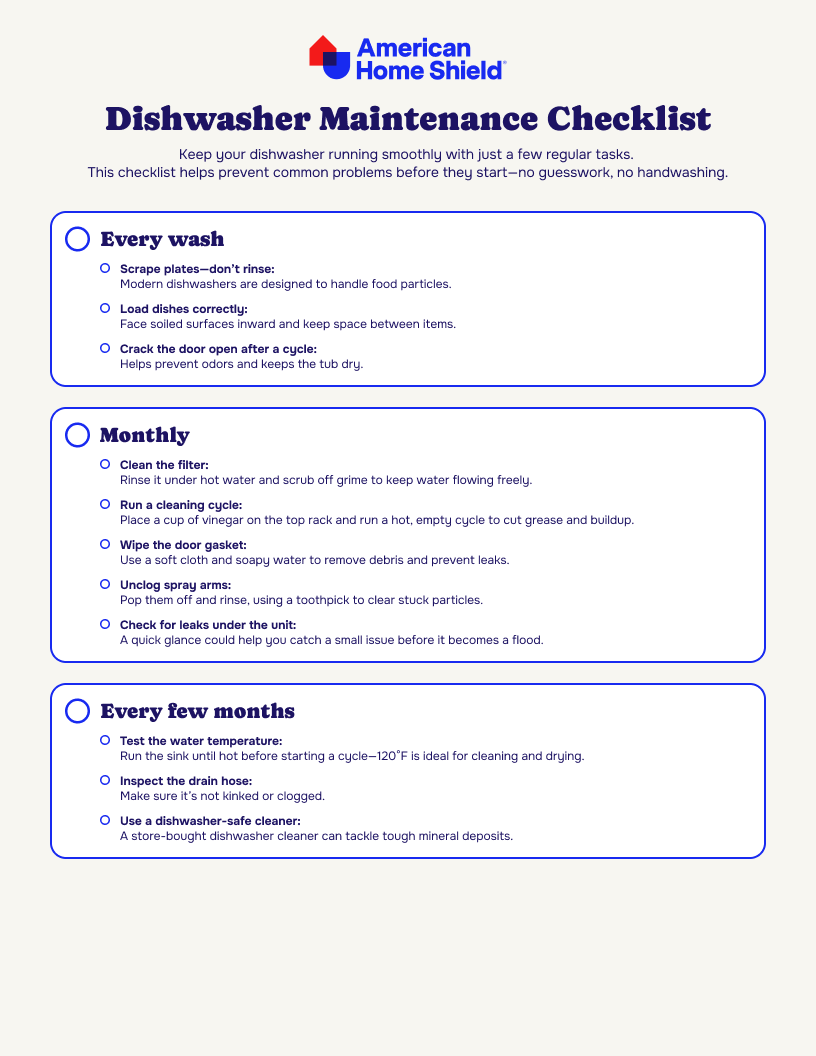
Avoid repeat issues with simple habits. Clean the triple filter weekly. It is the number one prevention step. Inspect the non-return valve monthly for debris. Use rinse aid to reduce mineral deposits. Run hot water in the sink before starting the dishwasher. Avoid pre-rinsing dishes. Modern detergents need food to activate.
Never put corn husks, potato peels, large food scraps, or plastic labels in the dishwasher. They belong in the trash, not your pump.
Know When to Call a Professional
Call Miele service or a technician if drain hose is cracked and cannot be replaced DIY, pump assembly needs replacement and you are not confident, electrical issues are suspected, F11 returns after full cleaning, or unit is under warranty.
Consider replacing the dishwasher if it is over 12 years old, multiple repairs have been done, pump replacement costs over $150 plus labor, or drainage issues keep returning.
Older units may not be worth repeated fixes.
Frequently Asked Questions About Miele Dishwasher Not Draining
What does error code F11 mean on a Miele dishwasher?
F11 indicates a drainage problem. It appears when water remains in the sump after the drain phase. The dishwasher tried to empty but could not. Common causes include clogged filter, blocked non-return valve, kinked drain hose, or failed drain pump.
How do I manually drain a Miele dishwasher?
Press and hold the power button, select a different wash program, and close the door. This triggers a new drain sequence. Repeat up to four times. If water drains, the issue may be temporary.
Why does my Miele dishwasher still have water after the cycle ends?
A small amount of water (1–2 cm) is normal to protect seals. Water above the filter indicates a drainage problem. Check the filter, non-return valve, and drain hose for blockages.
Can a clogged drain hose cause F11 error?
Yes. A kinked, looped, or clogged drain hose restricts water flow. Trace the entire hose from dishwasher to drain point. Look for sharp bends or compression. Clear any obstructions.
When should I replace the drain pump on my Miele dishwasher?
Replace the drain pump if the impeller spins freely with no resistance and all other components are clean. A free-spinning impeller indicates internal shaft breakage. This is the most reliable sign of pump failure.
Key Takeaways for Fixing Your Miele Dishwasher Not Draining
A Miele dishwasher not draining is almost always fixable without a service call. Start with the filter, then the non-return valve, then the impeller. Check the drain hose and garbage disposal connection. If the impeller spins freely, replace the pump. With regular maintenance, your Miele can run flawlessly for over a decade. Do not ignore standing water. Fix it now before mold or permanent damage sets in.