Dishwasher Not Spraying Water? Fix It Fast
You load the dishes, press start, and walk away—only to return to dirty plates and undissolved detergent. You peer inside and see water sitting in the bottom, but no spray. The telltale whoosh of the spray arms is missing. If your dishwasher is not spraying water, you’re not alone. This is one of the most common appliance failures, affecting cleaning performance and leaving food residue behind.
The root problem is not always a broken part. In fact, over 90% of spray failures stem from clogs, simple mechanical issues, or overlooked maintenance. The good news? Most fixes are DIY-friendly and cost little to nothing. Whether you own a Whirlpool, Bosch, LG, Samsung, or GE, this guide walks you through a step-by-step diagnostic process to pinpoint and solve the issue fast.
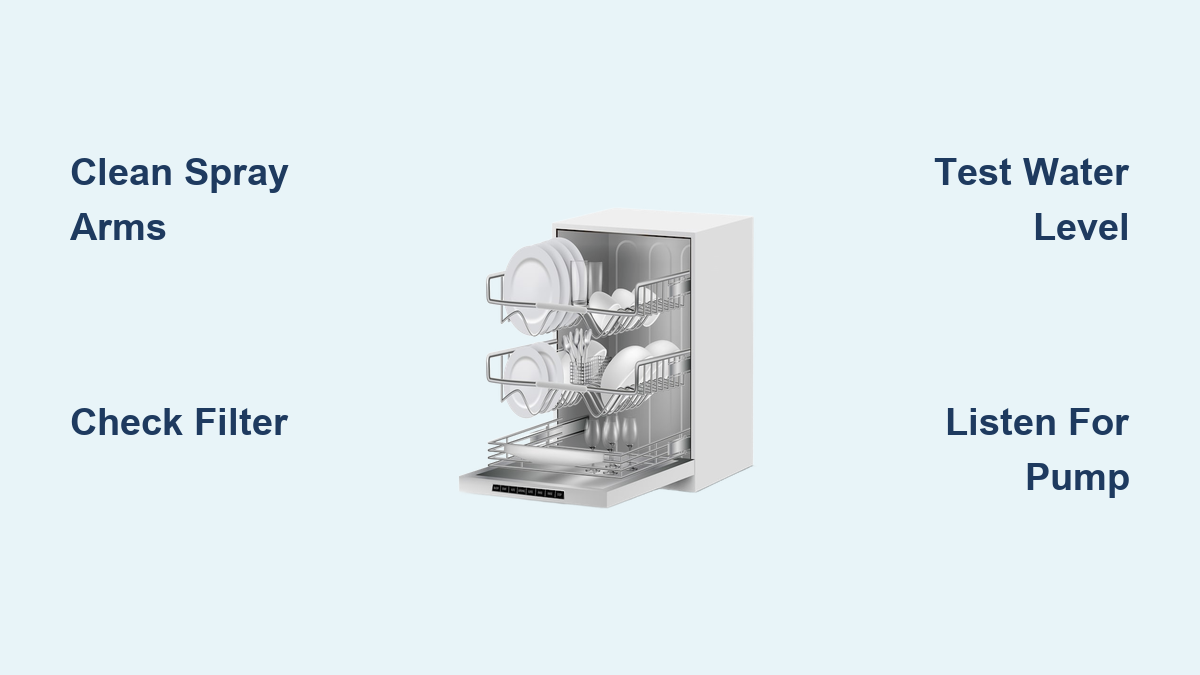
Clean Spray Arms & Filter First

Start with the most common cause: blocked water flow. Over time, food debris, mineral scale, and labels clog spray arm jets and filters, killing water pressure.
Remove and Inspect Spray Arms
Take out both upper and lower spray arms. Most lift or twist off.
• Hold each arm up to a light. Look for clogged holes.
• Shake them. Rattling means internal debris like broken glass or toothpicks.
• Use a toothpick or pipe cleaner to clear every nozzle.
• For hard water buildup, soak in white vinegar for 30 minutes, then rinse.
Reinstall and spin manually. If they do not rotate freely, clean further or replace.
Pro Tip: LG QuadWash and Samsung Zone Booster models have more nozzles. Inspect all jets closely.
Clean the Filter Assembly
The filter traps food particles at the tub base. A clogged filter reduces water flow and mimics pump failure.
• Locate the filter (usually star-shaped or cylindrical).
• Twist or lift to remove.
• Rinse under hot water.
• Scrub mesh with a soft brush.
• Check for tears. Replace if damaged.
Model Note: Bosch and GE often use self-cleaning filters, but they still need occasional manual cleaning.
Check Water Level After Fill

Low water means the circulation pump cannot prime. No pressure equals no spray.
Test Water Depth
• Start a normal cycle.
• Wait 3 to 4 minutes (after fill phase).
• Open the door carefully.
• Water should touch or slightly cover the heating element.
If not, the tub is not filling properly.
Perform Manual Water Test
• Add 2 to 3 quarts of warm water to the tub.
• Close the door and restart the cycle.
• If spray resumes, the inlet valve is clogged.
Never clean the inlet valve screen. It is sealed. Attempting to clean it risks leaks or flooding.
Listen for Circulation Pump Sound
The wash motor powers the pump. If it fails, no water sprays despite adequate fill.
Identify Normal vs. Faulty Sounds
• Normal: Loud, continuous whooshing after fill.
• Faulty: Silence, humming, or buzzing.
After the fill phase, open the door slightly and listen.
• No sound? Motor may be dead.
• Humming? Motor is trying but seized or overloaded.
• Clicking? Could be control board or relay issue.
Model-Specific Alerts: Whirlpool WDT540HAM series shows F4E3 error for pump failure. LG models over 6.5 years old often fail due to worn pumps.
Test Motor with Multimeter (Advanced)
• Turn off power at the breaker.
• Access the motor under the unit (remove toe-kick panel).
• Disconnect the motor plug.
• Set multimeter to measure resistance (ohms).
• Test across terminals. Infinite resistance equals bad motor.
If voltage reaches the motor but it does not run, the pump is faulty.
Inspect Sump & Chopper Assembly
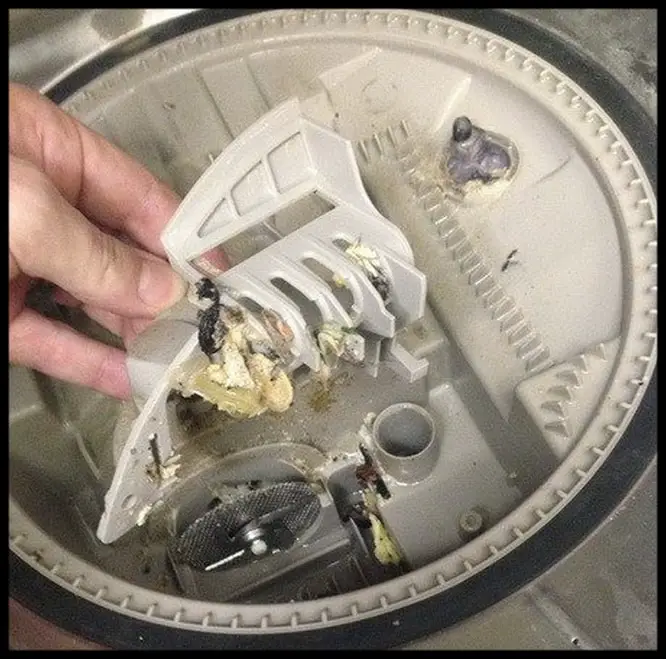
The sump is the lowest point where water collects before being pumped. Debris here can block the pump intake.
Clear the Sump Area
• Remove the lower rack and spray arm.
• Shine a flashlight into the sump.
• Look for food chunks, broken glass, jar labels, or chicken bones.
Whirlpool and KitchenAid models often have a chopper blade that grinds food. If it is not spinning, something is jammed.
GE Piranha models use a high-speed disposer (3,600 RPM). Check for obstructions.
Check the Orange Filter Ball (Whirlpool/KitchenAid)
• Found inside the pump housing.
• Traps grease and sludge.
• Gently jiggle with a screwdriver.
• If stuck, flush with degreaser or vinegar.
• Replace if brittle or cracked.
Diagnose Diverter Motor Failure
In models with upper and lower spray arms, a diverter motor alternates water flow between levels.
Spot Diverter Problems
• Upper rack stays dirty while lower rack is clean.
• Spray arms rotate only partway.
• Error code F9 on display (some Whirlpool/LG models).
The diverter is usually under the sump or at the back of the tub. It uses a rotating disc to route water.
Test and Replace
• Access may require removing the sump.
• Check for corrosion on motor, seized shaft, or obstructions in the path.
• If the motor does not turn, replace it.
Fix Upper Spray Arm Connection
Even if water sprays below, the upper rack may get no flow due to a failed feed system.
Common Causes
• Loose upper rack not fully docked.
• Cracked feed tube (plastic riser from tub to arm).
• Failed rubber gasket or flapper valve.
• Rear manifold seal leak (common in Bosch and Samsung).
Troubleshoot Step-by-Step
- Ensure the upper rack is fully seated in its tracks.
- Remove the upper spray arm.
- Run a short cycle.
- Check for water shooting from the rear feed nozzle.
No flow? The connection is blocked or failed.
Repair Options
• Realign rack if mispositioned.
• Replace rubber gasket (5 to 15 dollars).
• Swap feed tube assembly if cracked (20 to 40 dollars).
Run a 10-Minute Diagnostic Check
Use this quick sequence to catch 90% of spray issues:
- Clean spray arms and filter. Remove, inspect, clear clogs, reinstall.
- Check water level. Should cover the heating element. If not, suspect inlet valve.
- Listen after fill. Whooshing equals good. Silence or hum equals pump or motor issue.
- Add water manually. If spray returns, replace inlet valve.
Know When to Repair or Replace
Not every fix is worth the cost. Use this guide to decide:
| Issue | Repair Cost | New Dishwasher | Verdict |
|---|---|---|---|
| Clogged filter/spray arms | 0 to 50 dollars | 400+ dollars | Repair |
| Inlet valve failure | 31 to 130 dollars | 400+ dollars | Repair |
| Diverter motor | 60 to 120 dollars | 600+ dollars | Repair if under 5 years old |
| Circulation pump | 250 to 500 dollars | 800+ dollars | Replace if unit over 7 years |
| Multiple failures | Over 500 dollars | 800 dollars | Replace |
Rule of Thumb: If repair exceeds 50% of replacement cost, get a new unit.
Best Value Pick: A Whirlpool-built model at 399 dollars offers reliability and parts availability.
Prevent Future Spray Failures
Keep your dishwasher running strong with simple habits.
Clean Monthly
• Spray arms: clear all holes.
• Filter: rinse and scrub.
• Run a cleaning cycle with 1 cup white vinegar (top rack) or an Affresh tablet.
Fight Hard Water
• Use rinse aid daily.
• Refill water softener salt (Bosch/Miele models).
• Install an in-line softener if hardness exceeds 7 gpg.
• Avoid phosphate-free detergents in hard water areas.
Avoid Mistakes
• Never clean inlet valve screen. Replace the whole part.
• Do not overload. Leave space around spray arms.
• Do not over-tighten hose clamps. Can crack fittings.
• Never test voltage while unit is wet.
Frequently Asked Questions About Dishwasher Not Spraying Water
Why is my dishwasher filling with water but not spraying?
The most likely cause is a blockage in the spray arms or filter. Food debris, mineral buildup, or broken glass can clog the nozzles and prevent water from circulating. Start by removing and cleaning both spray arms, then check the filter at the tub bottom.
How do I know if my dishwasher pump is broken?
Listen carefully after the fill phase completes. You should hear a loud, continuous whooshing sound. If you hear silence, a low hum, or clicking noises, the circulation pump or wash motor likely failed. You can test with a multimeter, or simply replace the pump if other causes are ruled out.
Can I fix a dishwasher not spraying water myself?
Yes. Over 90% of spray issues are caused by clogged spray arms, dirty filters, or minor obstructions. These are all DIY-friendly fixes that cost nothing. Only the pump motor, inlet valve, and diverter motor require parts and moderate skill.
How much does it cost to replace a dishwasher circulation pump?
Part costs range from 100 to 500 dollars depending on your dishwasher brand and model. Professional labor adds several hundred dollars more. On units over 7 years old, replacement is often smarter than repair.
Does hard water affect dishwasher spraying?
Yes. Hard water causes mineral deposits that clog spray arm nozzles and the filter. Using rinse aid, installing a water softener, and running vinegar cleaning cycles monthly helps prevent buildup and maintains proper water flow.
When should I replace my dishwasher instead of repairing it?
Replace if repair costs exceed 50% of replacement cost, if the unit is over 7 years old with multiple failures, or if you face repeated pump or motor issues. A new Whirlpool model around 399 dollars offers better long-term value than expensive repairs on aging units.
Key Takeaways for Fixing Your Dishwasher Not Spraying Water
Start with the simplest fixes first. Clean the spray arms and filter before replacing any parts. Most spray failures are caused by clogs, not mechanical failure, and these take only minutes to resolve.
Check water level after the fill phase. If water does not cover the heating element, the inlet valve may be clogged and needs replacement. Never attempt to clean the valve screen. Replace the entire valve instead.
Listen for the circulation pump sound. A healthy pump makes a loud whooshing noise. Silence or humming indicates motor or pump failure. Consider the unit age before spending 250 to 500 dollars on a new pump.